What Scouts Actually Look For In Young Football Players
Free Joner Football Hub
Want more free training ideas?
Enter the Hub for free blogs, challenges, coach resources, giveaways and weekly Joner Football ideas.
Enter The Free HubEvery young football player wants the same answer to the same question.
What are scouts actually looking for when they watch you play?
I get this question from parents on the sideline, from coaches over coffee, and from kids on the grass after every camp I run. So I sat down with my team, pulled real interviews from recruitment staff, looked through sport science research, and combined that with what I have seen across thousands of players I have coached.
Here is the honest answer. There are six things that show up again and again. Some will surprise you. The last one is the most important.
Watch The Full Video
This blog comes from the Joner Football video What Scouts Actually Look For In Football Players. Watch it first if you want the full explanation, then use this article as your notes.
1. Technical Ability Under Pressure
Manchester United recruitment staff have said it clearly. Technique is one of the biggest things scouts look for in a young player.
But this is the bit that gets missed. Scouts are not watching your highlight reel. They are not watching you juggle in the warm-up. They want to see what you can do in a real game, when someone is on you, when the pitch is tight, and when the wrong pass loses the ball.
The signal they watch for is the scan. Did you check your shoulders before the ball arrived? Did you know the pass you were going to play before it landed at your feet? The best young players decide first and receive second. Everyone else receives first and then panics.
If you coach kids, this is the single rule worth running for the next six weeks. Add a defender to every passing drill. Make every player scan before they touch the ball. Call it out if they do not. You will see a different player on a Saturday.
2. Game Intelligence
I coach thousands of players who are technically outrageous and still get cut at trials. The gap is game intelligence.
Scouts describe it like chess. They want a player who is thinking three or four moves ahead, not reacting to what already happened. Where is the space? If we lose the ball right now, where do I need to be? What is the right run to make for my striker?
A player with game intelligence works just as hard without the ball as with it. That is what a scout sees from the touchline. The player with the ball gets one second of attention. The player making the right run gets the next twenty.
3. Mentality And Resilience
I am going to tell you the academy story I tell every parent who asks me what gets a kid signed.
Years ago I took my UK academy team to play one of the top clubs. We got hammered. 9 nil. There was one boy in my team who refused to drop his head. He kept running. He kept tackling. He kept asking for the ball when his teammates were hiding from it.
Two weeks later that boy got pulled out of my academy and signed straight into theirs. Not for his technique. For his mentality.
Research across academy players backs this up. Work ethic, determination, and attitude can be just as important as technical skill when scouts are making decisions. They are watching how you respond when things go wrong.
Parents, this is the one for you. The sideline you create matters. When your kid makes a mistake and looks to the touchline, what they hear in that second either breaks them or builds them. Make mistakes a normal part of the game. That is how resilience is built.
4. The Science Most People Ignore
A 2023 study looked at what happens when multiple scouts watch the same player. The finding was that scouts disagree more than you would expect. They generally agreed technique mattered. After that, they were all over the place.
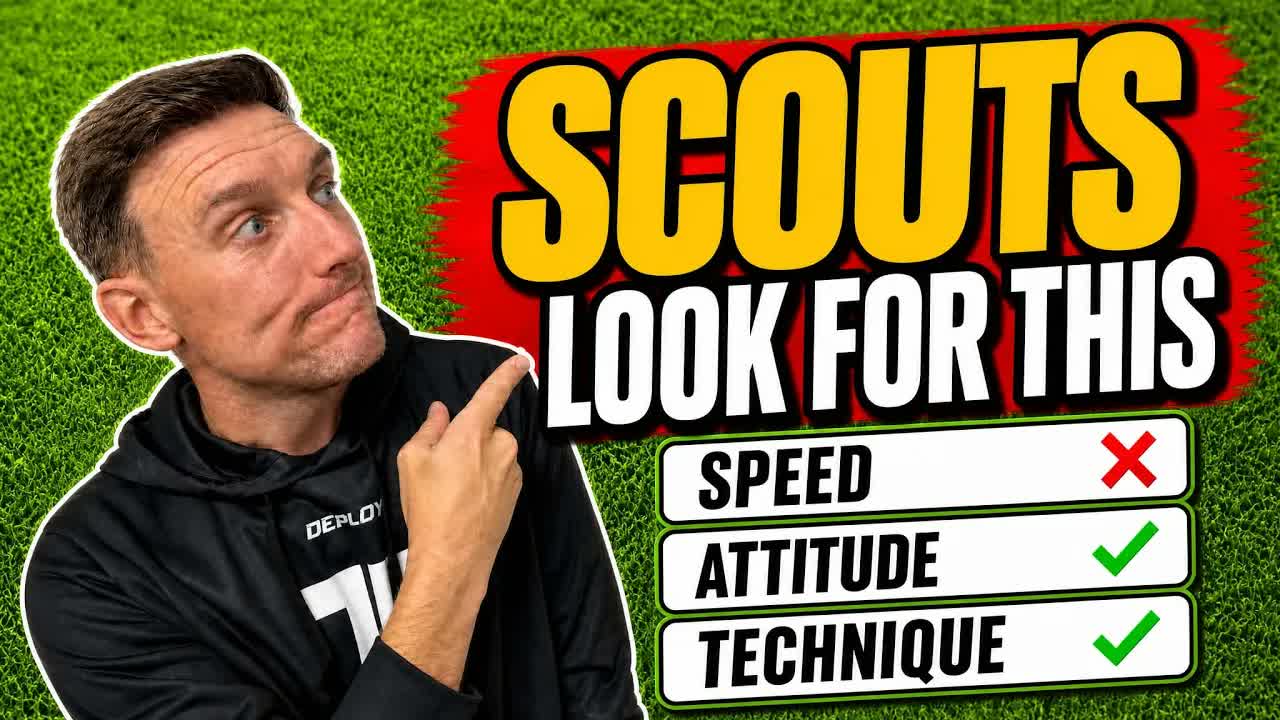
But when scouts ranked what actually predicts long-term talent, the order was clear. Top of the list: technical ability, decision making, and inner motivation. Bottom of the list: body size, measurements, and fitness levels.
That last bit is important and parents need to hear it. The biggest, fastest, most physical 12 year old does not win long term. They might win the U13 game. They are not automatically who scouts back five years out.
The kid who genuinely loves the game and trains because they want to is the one clubs invest in.
5. Being Coachable
For me as a coach, this is one of the biggest ones. There is nothing worse than seeing a baller who is amazing technically and impossible to coach.
Research surveying experienced youth coaches and technical directors found coachability ranked alongside flair, vision, and versatility as one of the most valuable attributes. Coaches and scouts want a young player who wants to improve.
Coachable does not mean you have no opinions. It does not mean you say yes to everything. It means you have the maturity to know you do not have all the answers yet. You listen. You take constructive feedback. You apply it. That trait travels with you forever.
For every coach reading this, you know exactly what I mean.
6. Do Not Play For The Scout
This is the most important point and the easiest one to forget on the day a scout actually shows up.
A large-scale Dutch study surveyed 125 professional scouts. Out of those 125, approximately 120 had a completely unique ranking of what they valued in a player. Read that twice. 120 out of 125 had different orders of priorities.
Football is a game of opinions. The proof is everywhere. Eberechi Eze was released by Arsenal at 13. He is now playing at the top level. Harry Kane was not always seen as the superstar in his age group, then one opinion changed the way people looked at him.
If you go into a game trying to perform for the scout, you will play tighter, more cautious, and second-guess yourself. You will hide the exact things that make you stand out.
So play your own game. The non-negotiables look after themselves.
The non-negotiables are the things that do not require talent. Be coachable. Present yourself well. Clean boots. Work rate. Compete on every ball. Scouts notice the lot.
Where To Train The Things Scouts Actually Rate
Inside the Joner Football app, we are stacking work that targets every one of these six points. Game intelligence drills, scanning sessions, decision making under pressure, off-ball positioning, mentality content, and coach education.
It is built around what scouts watch on a Saturday, not what looks good on a phone.
If you want to browse before signing up, the free section is open. If you coach a team, the coaches section is built for session planning and player development.
The Bottom Line
Scouts are watching the things you cannot see on a highlight reel. The scan. The decision. The reaction to a mistake. The way you carry yourself when nobody on your team can find a pass.
Those are the habits that get a 13 year old pulled into an academy after a 9 nil hammering. Those are the habits that get players noticed when everyone else is chasing tricks and clips.
Train them on purpose. Stop chasing the things scouts already told us do not matter long term.
Coach Lee<br />Joner Football
Keep improving
Choose your next training step.
Use the guides below to move from reading into proper Joner Football training.
Get The Free Hub
Drop your email once and get free Joner Football blogs, challenges and coaching resources.
Enter The Free HubTake Your Training Further
For 1,500+ drills like these, join the Joner Football App.