How To Coach Different Ages With One Drill Setup
Free Joner Football Hub
Want more free training ideas?
Enter the Hub for free blogs, challenges, coach resources, giveaways and weekly Joner Football ideas.
Enter The Free HubGood coaches do not need to change the whole drill every time they work with a different age group.
They need to know how to adapt.
That is the key.
A lot of coaches overcomplicate their sessions because they think every group needs a brand new drill, a brand new layout, and a brand new idea.
You do not need that.
You can use one simple setup and still challenge a beginner, a younger player, an older player, and a high-level player.
The drill does not have to change much.
The progression does.
The Setup Stays Simple
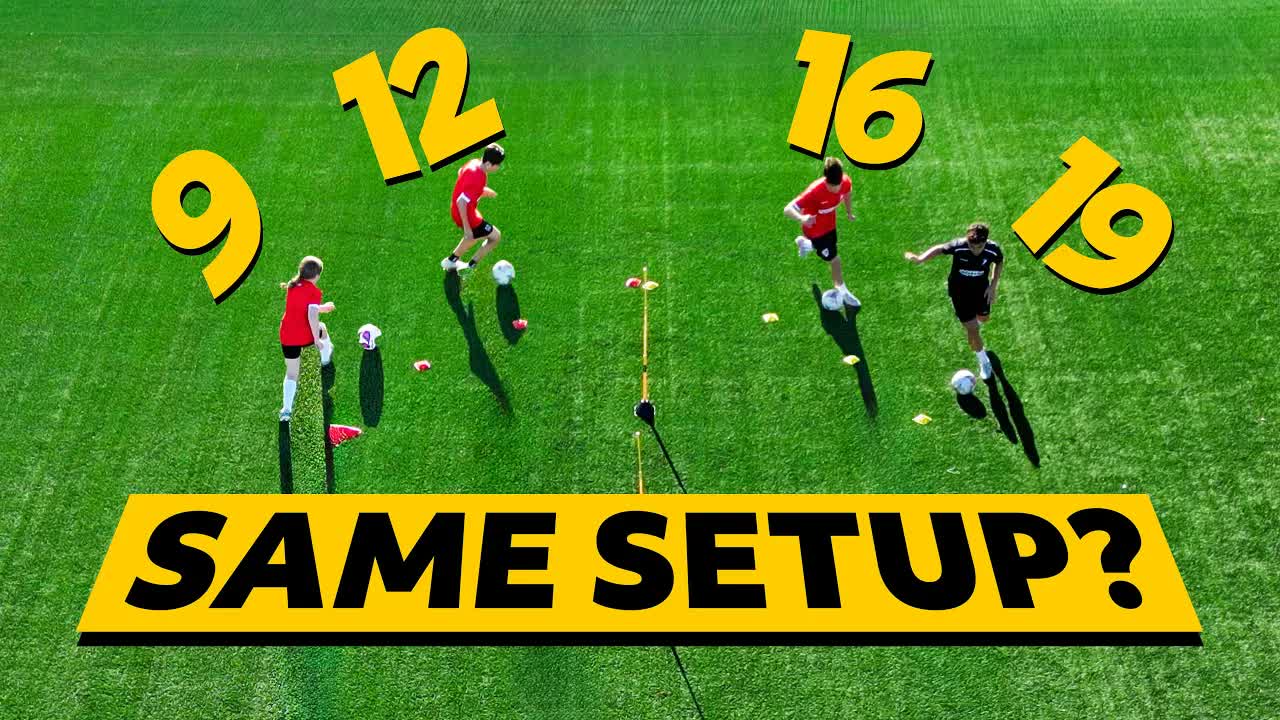
For this session, the setup was basic.
Two poles. Four yellow cones. Four red cones. An iPad at the back. Some footballs.
That was it.
Nothing fancy. Nothing overdesigned. Nothing that needs 25 cones and a coaching manual to explain.
But from that one setup, we worked with four different players across different ages and levels.
The outcomes stayed similar:
- •First touch
- •Bounce passing
- •Dribbling
- •Awareness
- •Reaction
- •Change of direction
- •Ball speed
- •Communication
The difference was not the setup.
The difference was the detail.
Younger Players Need Clarity And Confidence
With a younger player, the first job is not to make the drill look advanced.
The first job is to make the detail clear.
In the first progression, the focus was on first touch, bounce passes, both feet, and a simple reaction into dribbling.
The coaching detail was simple:
- •Open the foot
- •Play through the middle of the ball
- •Keep the ball in front
- •Use both feet
- •Keep the dribble tight
- •Lift the eyes
That is enough.
Younger players do not need ten coaching points at once. They need a clean picture, a clear task, and short feedback they can actually use.
If the bounce pass lifts, coach the contact. If the dribble gets messy, coach the touch size. If the player looks down the whole time, coach the eyes.
Simple setup. Simple language. Clear standards.
That is good coaching.
The Next Progression Should Only Add One Layer
With the next player, the setup stayed the same.
Only one simple progression was added.
The bounce pass was still there, but now the player dropped back between the poles and had to develop the weight of the touch across.
That one change made the practice harder.
Now the player had to think about:
- •The softness of the bounce pass
- •The weight of the first touch
- •Body shape
- •Scanning
- •The next action
- •Adjusting to different pass speeds
This is where coaches need patience.
You do not need to add five things at once.
Add one layer and see how the player handles it.
If they struggle, slow the pass down. If they are flying, increase the speed. If they are on toast, make the detail sharper again.
The coach adapts the feed, the speed, and the challenge.
The setup stays the same.
Older Players Need More Pressure, Not More Clutter
For an older or stronger player, the drill can become much more demanding without changing the whole area.
In the third progression, the practice became harder through a figure of eight dribble, bounce pass, touch through the middle, awareness at the back, and another dribbling action.
The outcome was still the same.
Passing. First touch. Dribbling. Awareness.
But the challenge was higher.
The player now had to deal with rhythm, flow, speed, change of direction, shoulder checks, calling information, and sharper touches under fatigue.
That is the lesson for coaches.
To challenge older players, you do not always need a bigger drill.
You need more pressure inside the same drill.
More speed. More information. More scanning. More realistic reactions. More demand on the touch.
That is how a simple setup becomes a high-level practice.
High-Level Players Need Consistency And Realism
With a high-level player or coach, the progression can become even sharper.
The final version added more thinking, more fatigue, more change of direction, and more freedom to be creative.
The player had to dribble around the area twice, deal with different passes, check shoulders, change direction, receive under pressure, and still keep the quality high.
At that level, the coaching points change.
You are not explaining every basic movement.
You are looking for consistency.
Can they keep the same quality when tired?
Can they check shoulders without being reminded?
Can they react at speed instead of waiting for the coach?
Can they use a skill with purpose?
Can they make the drill feel like the game?
That is the difference.
Beginners need clarity. High-level players need realism and consistency.
Same setup. Different demand.
Do Not Overcomplicate The Drill
A common coaching mistake is thinking complexity equals quality.
It does not.
A complicated drill can still be poor.
A simple drill can be brilliant if the detail is right.
The best coaches are not always the ones with the most creative session diagrams. They are the ones who know what to look for, when to progress, when to simplify, and how to adapt the same practice to the player in front of them.
That is the art of coaching.
One player might need help with contact on the bounce pass.
Another might need help with body shape.
Another might need scanning.
Another might need the tempo pushed higher.
That does not mean you need four different drills.
It means you need four different coaching points.
Progress The Player, Not The Cones
This is the big takeaway.
Coaches should not obsess over changing cones.
They should obsess over changing the challenge.
You can progress a drill by changing:
- •The speed of the pass
- •The number of touches
- •The distance
- •The required foot
- •The direction of the first touch
- •The amount of scanning
- •The reaction cue
- •The fatigue level
- •The decision after receiving
- •The quality expectation
That is where the coaching lives.
Not in making the diagram look clever.
In making the player better.
The Bigger Lesson
Good coaches adapt to the level and age they are working with.
That does not mean changing everything.
It means understanding what each player needs from the same setup.
A nine-year-old might need confidence, clean contact, and simple reactions.
A 12-year-old might need better touch weight and body shape.
A 15-year-old might need rhythm, awareness, and sharper speed.
A high-level player might need consistency, realism, and detail under fatigue.
Same drill.
Different progressions.
Different coaching.
That is how you keep sessions simple without making them basic.
Watch the full video here: How I Coach Different Ages With One Setup.
If you want more coaching detail like this, the Joner Football App has a coaches section with drills, sessions, and coaching ideas for different ages and ability levels.
Keep the setup simple. Make the coaching better.
Keep improving
Choose your next training step.
Use the guides below to move from reading into proper Joner Football training.
Get The Free Hub
Drop your email once and get free Joner Football blogs, challenges and coaching resources.
Enter The Free HubTake Your Training Further
For 1,500+ drills like these, join the Joner Football App.